
Introduction
In FY21, more than 14 million new demat accounts were opened, an almost threefold jump from 4.9 million from the previous year, a trend that has continued this fiscal.
Retail ownership in more than 1,500 companies listed on the National Stock Exchange of India jumped to 9 per cent in the third quarter of 2020, the highest since March 2018.
Central Depository Services (India) opened a record 1.47 million accounts in January, and 1.36 million in February up more than threefold from the same months in 2020.
ABCD Broking ( Name Changed ), a securities firm established in 1987, says 72 per cent of the 510,000 customers it added from October to December 2020 had never traded stocks before.
Certain part of the Indian stock market rally, over the past 16 months has been fuelled by huge jump in first-time investors. Retail trading has been accelerating since the pandemic-fuelled market volatility brought new investors into the world of stocks, sometimes for the first time. Work-from-home, and higher personal savings levels, as well as various social media platforms have only accelerated the sudden boom in retail trading. Such excitement towards market investment hasn’t been seen in decades ( I remember similar excitement was seen in 2007 & 1999 ), as people of all ages jumped into the market to ride the wild moves. It is very important that these new traders should stay in the market in the long run and do not get washed away when the market trend reverses.
The objective of writing this article is to help these stock market participants to develop a logical & sustainable structure to approach stock market and it is not limited to any specific stock market. The rule is very simple –if you can survive you will make money.
Trading & Investing – Is it same or Different
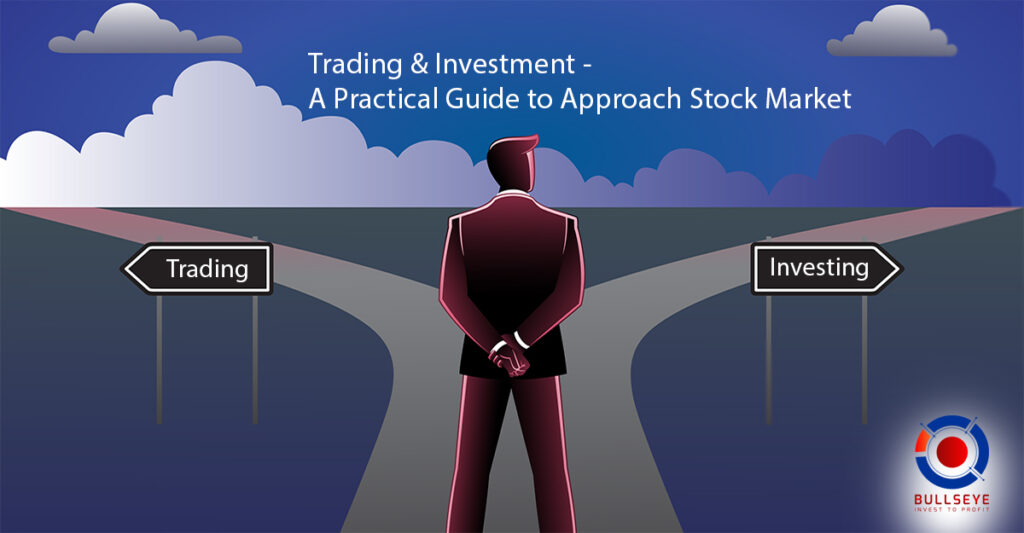
Let us start the discussion from very basic— What is trading in the stock market and what is investment from a professional point of view. Many people use the words “trading” and “investing” interchangeably and act accordingly. But the truth is they are two very different approach. General approach to trading and investment is — “when I buy a stock and it goes up –I sell it” —known as “trading”. And “when I buy a stock and it goes down—I hold it”— known as “investment”. The result of such process could bring a disaster to the market participant. Because during a market rally all good shares will be sold easily and shares whose price will not go up will remain in the portfolio. And when market trend reverses, we are stuck with those bad shares and price does not recover even though the market recovers in the future. The philosophy of trading is completely different from investment. While traders and investors participate in the same marketplace, professionally they approach the market using quite different strategies, and different psychological attitude. A market participant should be truly clear whether he wants to trade in the market or invest in the market. Trading strategies will not deliver optimum result if it is used for investing in the market and vice versa. Trading is all about understanding the price movement of the share of the company whereas investing is all about understanding the business of the company.
What is Investing
Investing is a long-term approach and the decision-making process is also relatively longer and complex than trading. The goal of investing is to create wealth in the long run by holding a portfolio of different asset class according to the risk appetite and risk attitude of the investor. Ideally a stock investor will invest in a company after analysing the sector performance, business potential of the company, management capabilities and the financial performance. Once the investor finds a suitable company according to his/her parameter he will buy it and sit tight. Investor should periodically check the performance of the company & study the management guidance about the future performance. An investor should never be disturbed with the short-term volatility in the price because he has bought the company not the price. His only focus is on the performance of the company. In the long run that is what drives the price. If you want to invest in the stock market it is advisable not to invest all your money in one or two shares. One should create a portfolio of shares from different sectors according to the performance and allocate fund to each share equally or according to the market capitalisation. Adequate diversification is very important because portfolio return will not be impacted in the long run even though one or two shares fail to perform, and it is relatively safer to create a large cap portfolio at individual level. For investment in small cap or micro-cap it is better to approach through mutual fund route.
So, the obvious question is what is the process an investor should follow.
Investment Process
In this article we don’t have much scope of discussing the investment process including the valuation methodology in detail because it is little complicated and require a good amount of experience along with the relevant educational background to implement it successfully. Most importantly, objective here is not become an analyst but to become a successful investor. We will try to develop a simple structure of the investment process in stock market considering the various background of the investors. One should stick to that process as much as possible.This is more a bottom-up approach i.e primary focus is on selecting the good company and hold it across the multiple economic cycle.
1) Buy core industries & simple business which is easy to understand and check whether the industry is growing or facing difficulty.
2) Look for companies which have at least 15 year track record. It proves the ability of the management to steer through various economic cycle.
3) Find out the market capitalization of similar size companies in the same industry. Top five should be considered.
4) Compare the companies selected above using the following ratios. (Dividend Yld, Price/Book, Debt/Equity, Current ratio, Net Profit Margin, RoE or ROCE and P/E)
5) Funds can be allocated within the top two or three.
6) Check the last 5 (minimum 3 ) years performance (sales growth, net profit growth, borrowings, reserve and dividend ) of the selected company.
7) If satisfactory and in line with the current performance check the price growth in similar period.
Once market ( Price ) confirms the fundamental performance — It can be bought. Remember you need to spend minimum one hour/week regularly ( depending on the background ) to get hold of the concepts and its application and there are ample of free website to check the required data.
What is Trading
Stock Trading is an activity of frequent purchase & sale of shares with an objective to generate regular profit. Ideally a stock trader buys a price and sells a price. Traders are primarily focused on trend and momentum of the stock price. Performance of the company is not relevant. Successful trading stands on three pillars- psychology, market analysis & trading system and money management. Remove any one, getting success will be difficult in trading. Among the three, psychology management is the toughest one and the most ignored one. Market analysis and money management can be learned in a short period but to manage our own emotions ( particularly greed and fear ) we need to tarin ourselves and practice a lot, and that is what differentiates between an amateur and a professional trader. Majority of the traders ride an emotional roller coaster and miss the essential element of sustainable winning —the management of the emotions. Almost twenty years of my experience suggests it is not important to have a very sophisticated system to be successful in trading. You only require a simple trading system but an extremely focused and disciplined approach. Please remember trading is a zero-sum game. Here money just transfers from losers to the winners. And sustainable long run winners are very, very less in numbers compared to losers.
Difference with Investment
Return objective and number of transactions – In investment number of transactions are very less and objective is more towards wealth creation. In trading number of transactions are very high while profit margins are relatively small.
Time horizon – In case of investments holding periods are very long, minimum 5 years and it can also extend up to twenty or more number of years. In trading holding period is usually very less ( from few hours to few months )compared to investment.
Selection Criteria of stocks for Investment & Trading – Traders usually depends on technical analysis to select the stocks for trading whereas investors select the company based on fundamental analysis.
Market segment – Usually traders are active in derivative segment whereas investors are more active in the underlying market.
How To Approach Trading
1) A trader must have a written trading plan & implement the plan with discipline.
What is a trading plan –
It is a written guideline for a trader and according to this guideline the trader should act in the market. It should include when to trade, how to trade & how much to trade and where to exit the trade. A trader should always plan his trade and trade his plan. Deviation from the trading plan means deviation in probability of making money from trading.
Trading Plan should cover the following area –
A) What is my trading capital – Trading is a business activity. One should allocate trading capital separately. Objective is to rotate this capital and not to block this capital. It is advisable to increase the capital only once in a year.
B) Allocation Strategy of that Capital – Prepare a list of five fundamentally strong share preferably from different sector and allocate your funds evenly depending on the opportunity. Always remember you should know what you trade and do not try to trade everything just because it can go up.
C) When to Trade and When not to – Never become a compulsive trader, instead become an opportunistic trader. Your trading system should help you to guide when to buy and when to sell and where to exit the position. Knowledge of technical analysis will help you to develop a trading system.
D) Objective Time Horizon – Traders generally fall into any one of the following four category.
a)Position Trader – Positions are held for several months.
b)Swing Trader – Positions are held from days to weeks
c)Day Trader – Positions are held throughout the day only with no overnight positions
It is advisable not to trade all the category. Because each category has a separate strategy. Please remember each category can be profitable but risk is different. Position trading is less risky compared to the other two categories. It is advisable one should stick between swing trading or position trading.
E) Stop Loss – It is a must for all the traders. In our life no matter how much we try we cannot avoid mistakes. But objective should be not to repeat the same mistake. Similarly in trading there will be some trades which will go wrong for many reasons and give loss. So as a trader we should be very clear about where to cut the loss and close the trade if the trade is not going according to our plan. This is known as stop loss. Traders should know where to place the stop loss and it should be decided according to the technical chart and volatility of the stock. Else, the price will hit the stoploss and reverse, creating frustration among the traders. Traders in general are very aggressive in booking the profit but extremely reluctant to cut the loss. Dr Daniel Kahneman observed investors are profit averse and risk takers. They normally, will not cut the loss unless forced to. It is always better to close the position at a small loss and recover the money later rather than taking a big loss. We all have a finite amount of capital and in trading the less we block our capital on a loss-making trade better it is. Objective is cut your loss early and let your profit run.
F) Post Market Routine – Trader must spend minimum half an hour a day to check the price chart of the selected five shares. One should not look into too many things. Just focus on the five price charts you are trading. Remember, Price Discounts Everything
2) Empowered with adequate knowledge and training to analyse the market condition ( Price Trend, Range, Momentum, Volume etc ).
Most traders get killed by one of two bullets- ignorance and emotion. Knowledge of technical analysis is very essential in trading. It helps a trader to identify the stock and also the price at which it should buy or sell the stock. It does not work with 100% accuracy, but it is your best guide available with 60-70% accuracy. Trading the market in the short term or very short term is like trying to swim in a turbulent sea. Knowledge of technical analysis is like your life jacket. It improves your chance of surviving but does not guarantee. With experience, traders will be able to handle this tool in a more mature way and improve profitability. Technical analysis as a subject is not at all difficult to understand and people from all professional and educational background can understand and apply this. It helps to remove emotion from trading. Now it brings up a very valid question. If it is so easy to understand and apply why so few numbers of traders are making money on a sustainable basis and majority is losing? Because very few traders can master their emotion and let the logic run while trading. Now again it brings up another very valid question. If emotion is causing so much trouble, we can manage that with the help of computerised programmed trading, where buying and selling happens automatically without any human interference. Very true, and that is what is happening across all the markets around the world. Large institutions and professional traders are using such strategies. And that is the reason why the profits are getting normalised gradually. But the silver lining is, there is a continuous flow of new amateur traders who are entering the water without understanding the basics and feeding the sharks. Hence you always have an opportunity as long as human gambling instinct prevails and each and every trader in the market does not use automated machine guns.
3) Equipped with adequate analytical tools
A charting software programme is essential for trading. Now days there are various free charting software available. Even most of the online brokers do provide a free charting platform. But one need to know how to use a chart, for this a trader should learn the subject. It is impossible to discuss the subject here or else I would have. It is simple, easy and require only two full days of training and hand holding for two-three month when taught & learned well.
4) Money Management
The primary goal of money management in trading is to ensure survival. One should avoid such risks that threatens the existence of the business. Following principals will help you to be in the game for long run and your profit will be ensured automatically.
A) One should never have more than five open positions at any time
B) Maximum commitment in one share should be limited to 20% of your capital
C) Amount risked in any one trade should be limited to 2% of the allocation in that trade.
D) Never average in trading.
E) For each trade profit objective must be determined and then balanced with the stop loss. Standard yardstick is 3:1 . Can be adjusted to 2: 1 maximum.
F) Do not reinvest the profit.
Should I become a trader or investor
Please remember both the activity is profitable as well as risky. Understanding your objective and personality at the very beginning will help you to identify whether you can be a trader or investor and enable you to employ the right tools and techniques accordingly. If the price volatility creates emotional turbulence once any position in the market is created, not comfortable with frequent entry and exit, cannot afford to analyze the market on a regular basis, not serious about discipline then choose to be a long-term trader or an investor.
It is advisable that let your investments be managed by professional and trade on your own by allocating a certain amount of capital after gathering the required knowledge.
Conclusion
A question might come to our mind why to get into so much learning and understanding when there are so many readymade free advice available from the brokers, newspapers, financial magazines etc .Very true. It is like fast food. Tasty but not healthy.
Disclaimer
Considerable care has been taken to prepare the above report. It may be possible some data error might be there. Readers are suggested to cross check any data if required. This report is not some advice to buy, sell or perform any other investment related activity. Please consult your investment adviser regarding any such activity
